
Sanctum in the Grid
2024
THIS IS AN AI GENERATED DEMO IMAGE
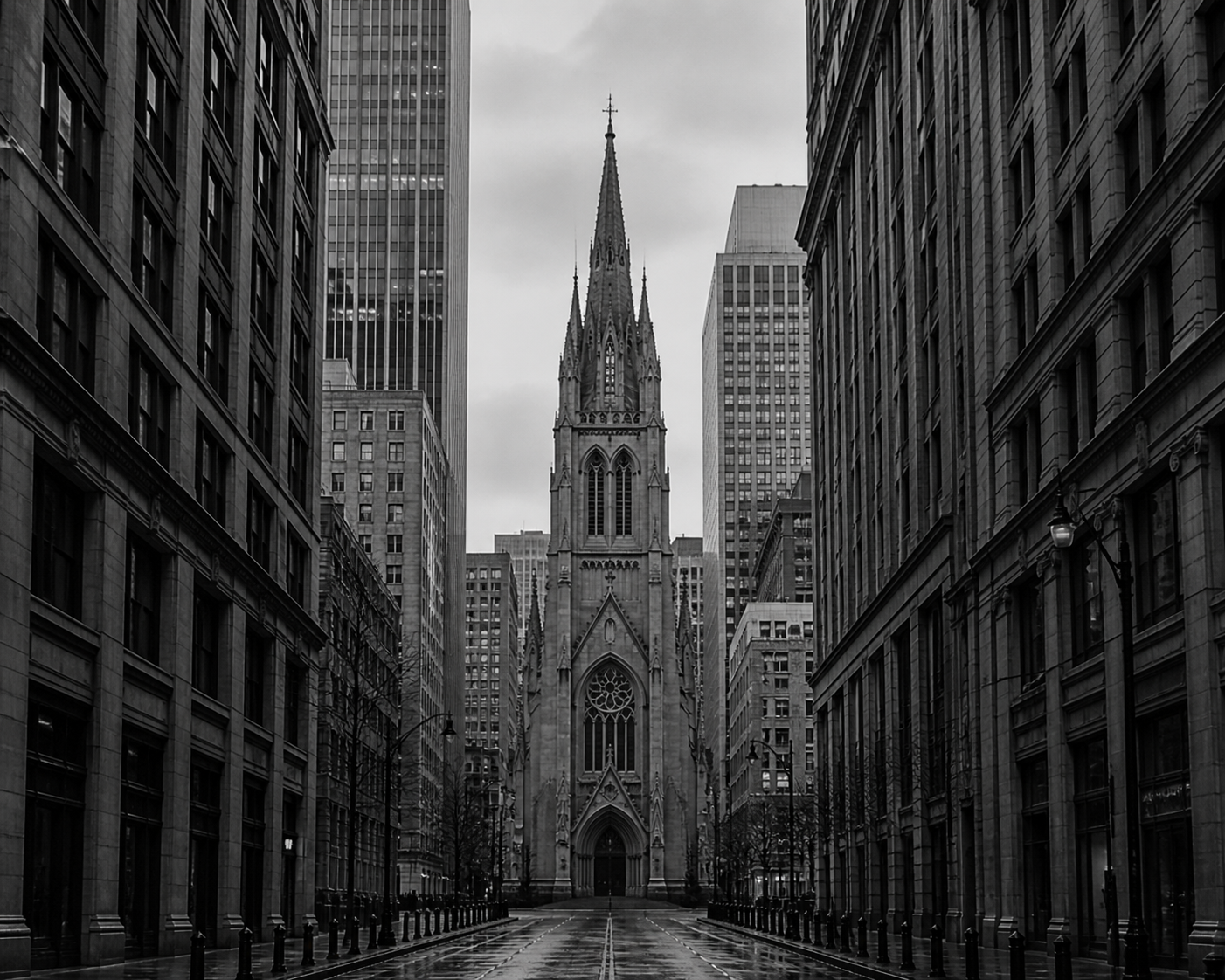
Centered within a rigid corridor of stone and glass, the church in Sanctum in the Grid presents itself as both anomaly and heir to the city that surrounds it. The photograph frames the structure with near-perfect symmetry: flanked on either side by tall office buildings, the Gothic spire rises from the vanishing point of a wet, reflective avenue, drawing the eye upward along a convergence of vertical lines. The composition makes the building unmistakably the focal point, but it also insists on a dialogue between architectural languages—an exchange of form, rhythm and material that is the work’s central preoccupation.
Rendered in black and white, the image reduces color to tone and texture, sharpening contrasts and unifying disparate materials under a single chromatic regime. The façade of the church, with its pointed arch portal, lancet windows, and carved tracery, is articulated by a fine gradation of grays that reveal the workmanship of stone. Its ornament—delicate rose window details, pinnacles and finials—retains a sense of hand-made intricacy. Against this, the neighboring towers present a different kind of detail: the repetitive grid of mullions and window bays, the planar expanses of masonry and the rectilinear logic of 20th-century commercial architecture. Yet the photograph insists that the distinction between ornament and repetition is not absolute. Both sets of façades employ verticality as their organizing principle; both repeat elements rhythmically up the elevation, and both frame the same sky. The modern buildings, austere and geometric, mirror the church’s aspirations to reach skyward, converting spiritual verticality into corporate height.
The street itself functions as an axis that amplifies the visual conversation. A wet sheen on the pavement—evidence of recent rain—creates a reflective surface that doubles the corridor of façades and intensifies the depth of the composition. Rows of short bollards and lampposts march along the sidewalks like a regiment, their regular spacing echoing the window rhythms above. A few leafless trees punctuate the scene with skeletal forms that, in silhouette, resonate with the pinnacles of the church. The absence of pedestrians or vehicular movement transforms the urban thoroughfare into a quiet processional space, lending the work a contemplative, almost ritualistic stillness.
Lighting in the photograph is diffuse and overcast. Shadows are soft, contouring rather than sculpting. This subdued illumination allows the tonal nuances of the stone and glass to come forward without dramatic chiaroscuro, emphasizing materiality over theatricality. The sky, a neutral backdrop, isolates the spire so that its filigree stands out in stark profile. The choice to present the scene in monochrome encourages a reading of architecture as form and pattern: the eye moves across planes and lattices, noticing how carved tracery converses with curtain-wall glass, how cornices and stringcourses align with the horizontal bands of neighboring façades, and how the street’s linear perspective organizes the whole.
Beyond formal qualities, the image stages a meditation on continuity and coexistence in the urban environment. The church reads simultaneously as relic and participant: it is an object of historical craftsmanship bordered by structures of later commercial necessity, yet it shares with them the same civic address and vertical ambition. There is a tension between preservation and progress that runs through the composition without resolving into polemic; the tone is one of quiet coexistence. The title, Sanctum in the Grid, points to this tension and to the ways sacredness can be nested within the impersonal rigor of the modern metropolis. The grid—literal in the street plan and figurative in the façades—frames the sanctum, turning a moment of spiritual architecture into a focal point of urban geometry.
Technically disciplined and quietly poetic, the photograph invites prolonged viewing. Attention shifts from the monumental to the minute: to the carved ornament around the portal, to the weathered texture of façade stones, to the glint on a wet pavement. Yet the image’s power ultimately derives from its structural clarity. By centering the church and aligning the surrounding blocks into a single perspectival field, the photographer constructs a visual thesis about balance and resilience in the cityscape. The work asks viewers to consider how different architectural vocabularies—ornate and austere, ancient and modern—operate together to define common civic space. In doing so, it reframes the built environment as a palimpsest of intentions, where the past is neither erased nor fossilized but actively engaged by the patterns and demands of the present.
Artwork Details
- Medium
- Gelatin silver print (black & white)
- Production Date
- 2024
- Dimensions
- 80 x 100 cm
- Framing
- Yes
- Status
- Available
- Price
- 1,000.00 GBP